

FPC Bryan at a glance
FPC Bryan is a minimum-security federal prison camp for women in Bryan, Texas, holding 618 women as of September 2026. It is a stand-alone institution, not a satellite camp outside the fence of a larger prison, on 37 acres of a residential neighborhood in Brazos County, northwest of Houston.
| Official name | Federal Prison Camp, Bryan |
|---|---|
| BOP code | BRY |
| Security level | Minimum; sentenced women only, no pretrial or holdover prisoners; stand-alone camp |
| Population | 618 (as of September 2026) |
| Visiting | Saturday, Sunday and federal holidays, 8:00 a.m.–3:00 p.m. · see visiting hours |
| Inmate mail | Inmate Name & Register Number · FPC Bryan · Federal Prison Camp · P.O. Box 2149 · Bryan, TX 77805 |
| Send money | Lockbox · Western Union (code city FBOP, DC) · MoneyGram (receive code 7932) |
| Phone | 979-823-1879 · Fax 979-821-3316 |
| Street address | 1100 Ursuline Avenue, Bryan, TX 77803 · Brazos County |
| Judicial district | Southern District of Texas, Houston Division |
| BOP region | South Central |
| Designated capacity | 720 |
| Housing | 4 housing units, all multiple-occupancy; no single cells |
| Special Housing Unit | None · anyone placed in detention is moved to another institution |
| Medical care level | Level 2 |
| Mental health care level | Level 2 |
| RDAP | Yes; English only |
| UNICOR | Yes · see work and UNICOR |
On this page
Most of the women here arrived on their own, through the front door, on a date set by a federal judge, so the self-surrender section below is the longest on this page. FPC Bryan is one of the federal prisons in Texas and falls under the Bureau’s South Central Region. The warden is Tanisha Hall, PhD.
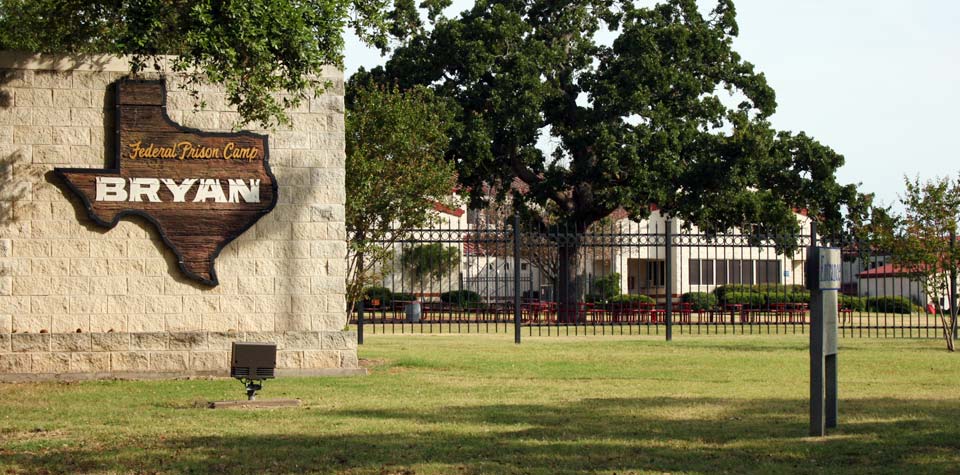
There is no FCI at Bryan. This is a stand-alone camp for women.
FPC Bryan is a stand-alone camp for women, with no FCI or other institution beside it. Most federal prison camps are satellites: a few hundred minimum-security beds outside the fence of a low or medium-security prison, sharing its warden, its clinic and its address. Bryan is not built that way. The Bureau’s roster lists six stand-alone camps in the whole system; two hold women, FPC Alderson in West Virginia and FPC Bryan. Every other camp that holds women is attached to a larger institution, such as the camp at FMC Carswell in Fort Worth, the only other institution in Texas that holds women alone; FDC Houston is listed on the roster as mixed.
The practical consequence is that there is nowhere on the grounds to move a woman when something goes wrong. The supplement says the camp “does not house holdover inmates and does not maintain a Special Housing Unit”; the 2026 PREA audit counted zero segregation cells; the handbook says a different institution is used for SHU placements, without saying which. In the two documented cases from 2025 described further down, it was the Federal Detention Center in Houston.
The Bureau’s web page for Bryan shows empty address blocks headed “For inmates at the Camp” and “For inmates at the FSL” and a heading for “Other facilities in this complex” with nothing under it; those are leftovers of a template shared by every institution, and the roster record for BRY carries no complex code. Reports that call the camp “FPC Bryant” or “low-security,” among them the BBC’s of August 1, 2025, have both the name and the security level wrong.
What is the security level at FPC Bryan?
FPC Bryan is a minimum-security camp, which for a woman means a security point total of 0 to 15 with no Public Safety Factor. The Bureau scores women on a different table from men: under the Bureau’s security designation rules, Program Statement 5100.08, the women’s table has three levels, 0 to 15 points for minimum, 16 to 30 for low, 31 and above for high. A Public Safety Factor overrides the arithmetic: a woman in the minimum range who carries a PSF for deportable-alien status, juvenile violence, serious telephone abuse, a sex offense, a threat to government officials or violent behavior is designated low, and a PSF for a prison disturbance or a serious escape sends her to the Carswell Administrative Unit, the Bureau’s high-security housing for women. Our guide to minimum-security federal prisons explains how the points are counted, and our guide to designation covers the rest of the process.
The sex-offender factor is the one that put this camp in the news. Program Statement 5100.08 says a woman whose current offense or history includes that conduct “will be housed in at least a Low security level institution, unless the PSF has been waived,” and that “only the DSCC Administrator is authorized to waive a PSF.” That is the rule the ranking members of the House Judiciary and Oversight Committees cited on June 16, 2026, when they wrote that Ghislaine Maxwell is here “despite BOP policies barring sex offenders from this minimum-security facility absent a special waiver.” No Bureau statement says whether a waiver was granted, or by whom.
What minimum security looks like here: custody levels of “Out” and “Community” on the 2026 PREA audit form; 21 buildings and four housing units, all multiple-occupancy, with no single cells; and a chain-link fence topped with coiled barbed wire, as NBC News described it in August 2025. The audit counted 887 admissions in the twelve months before March 2026 against about 600 women held on March 3, 2026, so much of this camp turns over every year. On May 28, 2026, the Bureau announced a Strategic Expansion of Minimum-Security Camp Utilization: institutions would begin transferring eligible people to camps once they have a Residential Reentry Center or home-confinement date, prioritizing at first those held in low-security institutions and excluding categories the release lists, among them sex offenders and deportable aliens.
How do I self-surrender to FPC Bryan?
To self-surrender at FPC Bryan, you drive to 1100 Ursuline Avenue on the date and by the time on the judgment, walk in at the front entrance, and report to the officer. Many women designated to a camp arrive this way, and the institution handbook is written for them: its closing paragraph addresses “individuals who are not yet in custody, and who have been given this publication to prepare for commitment.” The control room number is 979-823-1879. If the judgment leaves the time to the Bureau, call and ask; if it names one, be early. Our guide to how to prepare for prison covers the weeks before; this section covers the day.
What you may bring, and what happens to the rest
Almost nothing, and the rule is new. Program Statement 5580.10 (2026) says a woman who voluntarily surrenders “will be permitted to retain only” a plain wedding band without stones; one pair of earrings without stones worth under $100; medical or orthopedic devices; legal documents; religious items the warden approves, with any medallion and chain worth under $100; and prescription glasses. Her Social Security card, driver’s license and passport are kept in her central file until release, so bring them. Money she carries goes on her commissary account. Medication goes to Health Services, which decides whether to return it, so bring the labeled bottles and a written list of prescriptions. The institution ships home the clothes she wore in; everything else is mailed out at her expense. At this camp, the handbook says clear contact lenses may be kept only until glasses can be made and lost lenses are not replaced, so a woman who wears contacts should arrive in glasses.
Who can drive her, and where they wait
Family may drive her to the gate. The Bureau’s documents say nothing specific about surrender day, but the visiting supplement‘s rule for drop-offs is the best guide: people “being dropped off must instruct their driver to leave the property and return at a specific time,” and “are not permitted to remain in the parking lot or institution property.” Say goodbye in the car.
The first hours, the first week, the first month
Receiving and Discharge comes first: screening by unit staff, Health Services and Psychology Services, with a pregnancy test at arrival; unit orientation within seven days; a complete physical within fourteen days; and initial classification with the unit team within 28 days, where the PATTERN risk score is set and First Step Act eligibility is discussed. The handbook is explicit about the four self-assessment surveys on the TRULINCS computers: a woman who has not completed them is treated as having “opted out” and earns no First Step Act time credits, and credit runs from the day she finishes them, so do them in the first days. Declining a program the unit team recommends has the same effect.
Work starts almost at once. Every medically cleared woman “will initially be assigned to Food Service and will remain in this capacity for a minimum of 90 days” unless a trade earns her a direct assignment. Pay is 12 to 40 cents an hour on the institution scale and 23 cents to $1.15 in the UNICOR factory. Refusing the Inmate Financial Responsibility Program, the payment plan for restitution and fines, drops her commissary limit to $25 a month and closes the factory to her; skipping the drug-education course, mandatory where the presentence report documents drug use, costs pay grades too. The visiting list is the other thing to start at once: no one may visit until the unit team approves the visitor, and the handbook asks for requests for anyone beyond immediate family “at least three weeks in advance of the intended visit.”
Three rules that catch people at a camp
First, no fence stops anyone, and the law does not require one: escape “from any secure or non-secure institution” is a Greatest Severity prohibited act, code 102, and the three women discovered missing from this camp at about 10:15 p.m. on May 27, 2017, were pursued as escapees. Second, furloughs are real here: the Inspector General’s 2010 audit counted 2,735 non-transfer furloughs from Bryan in fiscal years 2007 through 2009 and 1,437 transfer furloughs, the unescorted trips by which a woman with community custody reaches a halfway house or another camp; sixteen ended in an escape record. Third, every woman back from a social furlough is drug-tested, and a positive test or a refusal is an incident report.
Who are the notable inmates at FPC Bryan?
FPC Bryan’s best-known prisoners are Elizabeth Holmes and Ghislaine Maxwell, both held there now; past prisoners include Jen Shah, Jennifer Leigh Ryan, Michelle Janavs and Sylvia Handy. The table gives each woman’s register number and her status in the Bureau’s inmate locator.
| Name | Status at Bryan | Case |
|---|---|---|
| Elizabeth Holmes | Currently held here. Reported May 30, 2023; projected release February 22, 2030 (register 24965-111) | Theranos founder; investor fraud, Northern District of California; 135 months |
| Ghislaine Maxwell | Currently held here. Transferred from FCI Tallahassee on or about August 1, 2025; projected release July 17, 2037 (register 02879-509) | Convicted in the Southern District of New York for her part in Jeffrey Epstein’s sex trafficking of girls; 20 years |
| Jennifer Shah | Former. Released from Bureau custody August 28, 2026, from the Residential Reentry Management office in Phoenix (register 37357-509) | “Real Housewives of Salt Lake City” cast member; wire-fraud conspiracy, Southern District of New York |
| Jennifer Leigh Ryan | Former. Released February 17, 2022, from FPC Bryan (register 25912-509) | Frisco, Texas real estate broker; 60 days for a January 6, 2021, Capitol-breach misdemeanor |
| Michelle Janavs | Former. NBC News (August 2025) reports a five-month sentence served here in 2020; the locator’s record shows her released November 16, 2020, from the Residential Reentry Management office in Long Beach (register 77816-112) | Hot Pockets heiress; college admissions prosecution, District of Massachusetts |
| Sylvia Handy | Former. Listed as Sylvia Sue Handy-Espronceda; released from FPC Bryan December 21, 2012 (register 59164-279) | Former Hidalgo County commissioner; 30 months in the Southern District of Texas (July 9, 2010) for conspiracy to harbor an illegal alien and a false statement on her 2005 tax return |
USA Today still described Jen Shah as a current Bryan inmate on September 8, 2026, eleven days after the locator recorded her release. The Bureau files Sylvia Handy under her hyphenated committed name, so a search under “Handy” alone finds nothing. Ruby Jane McMillan, whose name also appears as “Ruby Jane McMillian,” is listed by the Bureau under register 17577-035 and its Dallas reentry office; since the locator shows no past institutions, her time at Bryan cannot be confirmed.
Maxwell’s transfer is why a camp in Brazos County has been in the national news for a year. The Bureau confirmed on August 1, 2025, that she was “in the custody of the Federal Bureau of Prisons at the Federal Prison Camp (FPC) Bryan,” a week after two days of interviews with the then Deputy Attorney General, and she gave a closed-door video deposition to the House Oversight Committee from here on February 9, 2026.
How do I find someone at FPC Bryan?
To find someone at FPC Bryan, use the Bureau’s Inmate Locator, which is free, public and the only reliable source. Search by first and last name or by the eight-digit register number; for anyone held here the facility field reads “Bryan” with the type “FPC.” Names match the committed name on the judgment, so a woman known by a married name may be listed under another, and a hyphenated name may not come up under either half alone. After release the record keeps only the last office that held her, often a Residential Reentry Management office, and nothing on the locator shows the institutions she passed through. Our guide to register numbers explains the number itself; do not read the three digits after the hyphen as a code for the court, since the same 509 suffix appears above on a New York case and a District of Columbia case.
How do I write to someone at FPC Bryan?
Letters to a woman at FPC Bryan go to P.O. Box 2149, Bryan, TX 77805, not to Ursuline Avenue. Use the block below, with “Federal Prison Camp” written out as the handbook’s own address block has it. Her committed name and eight-digit register number go on the first line, and the handbook asks for the housing unit after them if you know it.
| Letters and approved packages | Not for inmate mail |
|---|---|
| Inmate Name & Register Number FPC Bryan Federal Prison Camp P.O. Box 2149 Bryan, TX 77805 | P.O. Box 2197 is the staff mailbox and 1100 Ursuline Avenue is the warehouse freight address. The 2026 PREA audit form prints Box 2197 as the facility’s mailing address; a letter sent there does not reach a prisoner |
Because this is a minimum-security institution, two rules are looser than at an FCI. Outgoing mail from a sentenced woman here “may be sealed by the inmate and is sent out unopened and uninspected,” and softcover books and magazines may arrive “from any source”; hardcovers and newspapers must still come from a publisher, book club or bookstore. Mail call is at 6:00 p.m. and 9:00 p.m. on weekdays, with no mail call on weekends or federal holidays.
A lawyer’s letter is opened in front of the woman it is addressed to and not read, but only if the envelope shows the attorney’s name and the words “Special Mail — Open only in the presence of the inmate”; an unmarked legal letter “may be opened as general correspondence.” See the Bureau’s correspondence rules and our guides to writing to a federal prisoner and to attorney-client communication inside the Bureau. General mail is forwarded for 30 days after a transfer or release and then returned.
How do I send money to someone at FPC Bryan?
Money for a woman at FPC Bryan goes to the Bureau, not to the camp. Every deposit for a federal prisoner goes through the Bureau’s lockbox in Des Moines or one of two wire services, and each needs the committed name and register number exactly as the Bureau has them.
| Route | Address or code | Timing, per the handbook |
|---|---|---|
| U.S. postal money order | Federal Bureau of Prisons Committed Inmate Name Eight-Digit Register Number Post Office Box 474701 Des Moines, Iowa 50947-0001 | Non-postal money orders and non-government checks are held for 15 days, and personal checks and cash are refused. A missing deposit is traced with whoever sold the money order, not the Bureau |
| Western Union Quick Collect | Code city FBOP, DC; register number with no spaces followed by the last name; committed full name on the attention line | Posted within two to four hours when sent between 7:00 a.m. and 9:00 p.m. Eastern; otherwise by 7:00 a.m. the next morning |
| MoneyGram ExpressPayment | Receive code 7932; company name Federal Bureau of Prisons, Washington, DC; up to $300 online | Same windows as Western Union |
Money sent to the wrong register number and accepted at the counter “may not be returned,” the handbook warns. A woman may send up to $100 a day out by TRUGRAM for a flat $4.95 fee. What each route charges a Bryan family per deposit is worked through in our guide to sending money to a federal prisoner. Before sending a large sum, read the commissary section: under the Bureau’s trust fund rules, store spending is capped at $460 a month, so a balance beyond that waits for the next month unless it goes on one of the items the policy leaves outside the cap.
What are the visiting hours at FPC Bryan?
Visiting at FPC Bryan is on Saturdays, Sundays and federal holidays, 8:00 a.m. to 3:00 p.m., with no visiting Monday through Friday. That is institution supplement BRY-5267.09C, signed by Warden Tanisha Hall, PhD, on January 7, 2025, which replaced the 2022 version under the Bureau’s national visiting regulations. Visitors must arrive by 2:00 p.m., and processing stops thirty minutes before every count, so on a weekend the desk closes at 9:30 a.m. for the 10:00 a.m. count and reopens once it clears.
The 2:00 p.m. arrival deadline applies on Sunday too: the visitor sheet attached to the supplement and the handbook both give 2:00 p.m. on Saturday and Sunday, although the supplement’s arrival-deadline table lists only “Saturday” and “Federal Holidays.” Listings that give weekend hours of 8:00 a.m. to 5:00 p.m., including the Bureau’s Spanish-language supplement, are out of date, for a reason explained below.
Who can visit, and how many
- Up to 30 people on the approved list, immediate family included. Every proposed visitor mails form BP-A0629 with a copy of a valid ID to the unit team; everyone 16 or older gets an NCIC background check.
- Five adults and five children at a time; a woman with more than five children may split the visit or request a special visit a week ahead.
- A parent or legal guardian, not the prisoner, signs the consent for anyone under 18, and visitors under 16 must be escorted by an adult on the list. A criminal record is not an automatic bar; the warden decides each case.
- One visit per visitor per day, with no leaving and returning; when the room fills, the duty officer ends visits weighing distance traveled and how often the visitor comes.
- The supplement rates the room at 570 people including children, with no non-contact areas. A handshake, embrace and kiss at the start and end, and holding hands throughout, are permitted; children under ten may sit on their mother’s lap.
What visitors can wear and bring
Shorts, skirts and dresses ending two or more inches above the knee are refused, and street shoes are required. Prohibited: heels over three inches, crocs and shower shoes, hooded tops, leggings, tights and jeggings, sundresses, sweatpants, camouflage in any color, anything resembling the khaki uniform or a staff uniform, jeans or shirts with holes, and hats, caps and scarves.
You may bring one clear plastic bag no larger than 4 by 4 by 12 inches, up to $40 or a card for the vending machines, one car key, one coat or sweater, feminine hygiene items and your photo ID; for a baby, eight diapers, a car seat or carrier, a change of clothes, wipes, a blanket, three clear bottles of breast milk, formula in a clear container, three unopened jars of baby food and two sealed bottles of water. Diaper bags, strollers, purses, phones, food, toys and reading matter stay in the car or a lobby locker. Photographs are taken between 11:00 a.m. and 1:00 p.m., and nothing else passes between visitor and prisoner: no papers, gifts, money or signatures. A woman who has recently given birth may nurse her baby in the legal visiting room, which the supplement sets aside for that purpose.
Identification and screening
Everyone 16 and older needs an unexpired state driver’s license, state ID card, passport or alien registration card, which the desk keeps until the visit ends; a visitor of 17 or younger who has never been issued a state ID may use a school ID. A visitor who cannot pass the walk-through detector for a medical reason needs a physician’s documentation meeting the Transportation Security Administration’s standard. Prisoners are pat-searched in and out, and half of them are visually searched on the way out under the Bureau’s search rules. Attorney visits are scheduled through the unit team 48 hours ahead and may be watched but not listened to. See our guides to federal prison visiting and to searches and contraband.
If your family reads the Spanish supplement
The Bureau still serves a Spanish-language visiting supplement for Bryan, BRY 5267.08D (2015), although the camp’s page does not link it. It gives weekend hours of 8:00 a.m. to 5:00 p.m. with arrival as late as 3:00 p.m., says ten percent of prisoners are searched leaving the room, and describes visits for women in special housing, which this camp does not have. The English supplement of January 2025 controls, and the Spanish edition itself names the English text as the document of record; a family that follows the Spanish hours arrives an hour after the desk closes. The Spanish handbook is a different case: it is the same February 2025 edition as the English handbook, including the out-of-date commissary and telephone figures corrected below.
Getting there
From Highway 6, take the Booneville Road exit (FM 158) west, turn right at the first light past the overpass onto Villa Maria Road, and follow it as it curves left and becomes Ursuline Avenue; the institution is on the right. From Texas Avenue, turn east on 23rd Street, which becomes Ursuline Avenue at the camp. Easterwood Airport serves the area, and Greyhound stops in Bryan.
How do phone calls and email work at FPC Bryan?
Calls at FPC Bryan go one way: a woman calls out to numbers on her approved list of up to 30, and no one can call in. Every call except a properly arranged legal call is recorded. The allowance is national, under the Bureau’s telephone regulations, Program Statement 5264.09, issued September 3, 2026: 510 minutes per calendar month, 300 of them free to a woman eligible for First Step Act telephone incentives; any woman who uses up those 300, eligible or not, may buy the other 210. A single call should generally not exceed 15 minutes, and at least 30 minutes must pass between completed calls. The 2026 policy rescinded the 2008 one, and with it the extra 100 minutes in November and December. Bryan’s February 2025 handbook, printed nineteen months earlier, still describes the old “300 minutes per month” and the holiday bonus; PS 5264.09 controls.
The handbook adds the local timetable. Phones here run from 6:00 a.m. until no later than 9:00 p.m., two and a half hours short of the national maximum, because quiet hours begin at 9:00 p.m.; on weekdays access is also restricted from 6:00 to 10:30 a.m. and from 12:30 p.m. until the 4:00 p.m. count clears, because women are expected to be at work. An unmonitored legal call is arranged through the case manager and must be justified by a need such as a court deadline. Email is TRULINCS, reached from outside through CorrLinks: text only, a per-minute charge to the prisoner, and no privilege for a message to a lawyer. Video visits cost $6.00 in TRU-Units for 25 minutes, scheduled four to 30 days ahead. Our guides to federal prison phone calls and CorrLinks and TRULINCS cover the systems.
What can people buy at the FPC Bryan commissary?
A woman at FPC Bryan may spend up to $460 a month at the commissary under the Bureau’s trust fund rules, Program Statement 4500.13, issued May 7, 2026; the limit rises by $50 during the November and December holiday period, for no more than one validation period. The camp’s 2025 handbook still prints “The National Spending Limit is $360.00”; PS 4500.13 records the increase from $360 to $460 and controls. Only eight categories sit outside the cap, and the manual calls its list exhaustive: postage stamps, nicotine patches and lozenges, over-the-counter medications and vitamins, kosher and halal shelf-stable entrees for women in IFRP refusal status, copy cards and copy paper, footwear, mattresses and the secured media device. Telephone credits are not on it and count against the $460. Special purpose orders for things the store does not stock are limited to one a month and $600 a quarter.
The store opens Monday through Thursday; the handbook says 6:30 a.m. to noon, the 2025 commissary list prints morning and afternoon sessions, and the posted unit schedule governs. Lists go in the day before, and a woman who leaves the sales window without something waits until the following week. The stock is a women’s store: mascara from $6.50 to $13.10, foundation from $10.90 to $25.30, hair relaxer at $9.75 and hair dye at $12.70, bonnets and wave caps, sports bras and panties by size, and tampons, pads and liners for sale beside the free ones the Bureau must supply. A tablet costs $131.30, a Timex watch $25.95, a clear radio $31.75 and a padlock $10.15; stamps come in books of twenty at $14.60. The sheet marks the items sold for kosher and halal diets and, separately, those sold to transgender prisoners, including a chest binder at $26.00. The handbook limits clothing to pastel green, gray and white, and the 2026 manual caps athletic shoes and watches at $150.
A woman shops by card or fingerprint. An “indigent” woman, one whose account has held less than $6.00 for 30 days, pays no medical copay and may request two over-the-counter items a week from the pharmacy; everyone else buys them. Our guide to the federal prison commissary explains the national rules.
What programs are available at FPC Bryan?
RDAP and drug treatment
FPC Bryan runs a Residential Drug Abuse Program, and it is on the Bureau’s current list: the August 2026 First Step Act Approved Programs Guide names “FPC Bryan (TX)” among 57 programs at 50 locations. The program here is English-language only; the handbook says so, and the guide’s Spanish marker sits beside FMC Carswell and FCI Miami, not Bryan. RDAP is a half-day program of at least nine months in a separate unit, followed by treatment in the halfway house, and a woman with a non-violent conviction who completes it may be considered for up to a year off under 18 U.S.C. § 3621(e). Admission turns on nearness to release, ordinarily with 24 months or more left to serve under the Bureau’s psychology treatment programs policy, Program Statement 5330.11, and on documentation of the drug problem, so have the history in the presentence report before sentencing rather than discover at Bryan that it is not there.
Psychology Services here is staffed, on the handbook’s count, by a chief psychologist, a drug abuse program coordinator, a Resolve coordinator, a staff psychologist, a technician and five drug treatment specialists. The August 2026 guide names BRY for Resolve, the Bureau’s trauma treatment program, which the handbook describes as a non-residential program for women with a history of physical or sexual abuse: a Trauma in Life workshop open to any of them, then counseling groups for those with a related mental health problem.
Education and vocational training
The mandatory literacy program is 240 hours toward a GED for anyone without a diploma, and English as a second language until she tests at eighth-grade level. The college partner is Blinn College, which the handbook lists for certificate programs in administrative assistant work, small business, medical transcription and coding, and accounting technology, and nothing else. Older listings of eight occupational programs here, from cosmetology to HVAC, do not match the handbook, so ask the education department in writing which programs are enrolling before anyone counts on one. There is an electronic law library and a leisure library with interlibrary loan. Our guides to prison education and vocational training explain the national programs.
Work and UNICOR
FPC Bryan has a Federal Prison Industries factory, described in three government documents. The August 2026 guide’s Federal Prison Industries entry names BRY in its list of institutions. The Justice Department’s Open Government Plan of September 2016 says the Bureau’s reentry hotline “is operated as a UNICOR call center, and provides job training to inmates at the Federal Prison Camp in Bryan, Texas.” And the 2025 handbook describes the factory’s onboarding: a Lean Six Sigma course before any on-the-job training, career testing so that “our ladies” are placed by aptitude, and a forklift certification class. UNICOR pays 23 cents to $1.15 an hour, against 12 to 40 cents on the institution’s performance pay scale, and the handbook says most institutions give its jobs first to prisoners with large court-ordered debts. Neither the Bureau’s page for Bryan nor UNICOR’s website says what the factory does today; the 2016 description is the most recent official one. Our page on UNICOR covers the national program.
Faith-based, reentry and the dog program
The chaplains run the Threshold reentry program and administer the certified religious diet under the Bureau’s religious practice rules; see our page on religious programs. Women here have raised puppies for Canine Companions, the assistance-dog charity, for more than a decade, working with a Texas A&M student group; its chief executive told NBC News in August 2025 that the charity does not allow anyone whose crime involves abuse of minors or animals, including any sexual crime, and that the puppy training is off limits to Maxwell. The August 2026 guide also names BRY for a Hydroponics and Gardening productive activity.
The guide’s programs-by-institution grid marks BRY for the Life Connections Program, a residential faith-based program, but the program’s own description names only CRW, FTD, GRE, MIL and THP; ask the unit team in writing before counting on it. The guide’s women-specific programs, from Women’s Basic Financial Literacy to Foundation, are approved for every institution that houses women, which is permission, not a promise that a class is running here this quarter.
What is daily life like at FPC Bryan?
Daily life at FPC Bryan runs on a work-day routine: wake-up at 6:00 a.m., the khaki uniform from 7:30 a.m. to 3:30 p.m. on weekdays, standing counts at 4:05 p.m. and 10:00 p.m., and quiet hours from 9:00 p.m. The 2025 handbook sets out the day as follows; treat it as the pattern, not a promise.
| Weekdays | Weekends and holidays | |
|---|---|---|
| Wake-up | 6:00 a.m. | |
| Breakfast | 6:30–7:15 a.m. | 7:00–8:00 a.m. |
| Khaki uniform required | 7:30 a.m.–3:30 p.m. | — |
| Standing counts | 4:05 p.m. and 10:00 p.m. | 10:00 a.m., 4:05 p.m. and 10:00 p.m.; compound secured at 9:30 a.m. |
| Lunch | 10:30–11:30 a.m., after a one-way move at 10:30 | 10:30–11:30 a.m., after the 10:00 a.m. count clears |
| Dinner | 4:30–5:30 p.m., once the 4:05 p.m. count clears | |
| Yard recall | 8:45 p.m. | 3:30 p.m. |
| Quiet hours | 9:00 p.m.–6:00 a.m., every woman on her own bed; no phones, email or day room | |
| Lights out | 10:30 p.m. | 11:30 p.m. |
| Mail call | 6:00 p.m. and 9:00 p.m. | None |
Housing is four multiple-occupancy units on the 2026 audit’s count, in rooms The Marshall Project’s reporters described in March 2026 as “dormitory-style rooms without doors.” Women may not undress in the dormitory and change only in the restroom and shower areas, which are individual stalls with doors. Male officers work the housing units, and several women told the auditor that individual officers did not consistently announce themselves on entering. Staff inspect and rate the rooms daily, and beds must be made every day.
Recreation is intramural sports, six-week wellness classes, and a hobby craft program of beading, knitting, crocheting and ceramics, with finished pieces mailed out within 30 days; the Zimmer Amendment rules in the Bureau’s recreation policy apply, so no R-rated films, no weight training instruction and no electric instruments. Our page on recreation in federal prison covers the national picture.
Medical care, and the hours no one is on site
Medical staff are at Bryan seven days a week from 6:00 a.m. to 4:00 p.m., and the handbook is explicit: “this institution does not have 24 hour on-site medical coverage.” After 4:00 p.m. an emergency goes to on-call staff or to a community hospital; the PREA audit names Baylor Scott and White Medical Center in College Station as the hospital used for forensic examinations. The Bureau’s 2024 care-level charts place Bryan at Medical Care Level 2 and Mental Health Care Level 2; our guide to care levels explains what those mean.
Routine care runs on a narrow window. Sick call is Monday through Thursday, 6:30 to 7:00 a.m., by triage form; dental sick call is 6:00 a.m. on the same days, while cleanings wait on a list. Pill line is 8:00 to 8:30 a.m. and 3:00 to 3:30 p.m., and refills are requested on TRULINCS no earlier than five days before the supply runs out. A prisoner-requested visit costs a $2.00 copay; chronic-care follow-up, prenatal care, mental health and emergencies are free. Ninety days of medication go home with a woman released to a halfway house, thirty with a woman released outright.
Pregnancy is handled under the Female Offender Manual, and the Bureau’s A&O guide for women’s institutions, issued here with the handbook, describes the two residential programs for women who carry to term, Mothers and Infants Together and the Residential Parenting Program. The handbook, dated February 7, 2025, cites the manual as Program Statement 5200.07, but the Bureau reissued it as 5200.09 on February 19, 2025, twelve days later, and amended it again on July 31, 2025; the choice the handbook describes survives in the current manual, but since the July 2025 change a woman who ends a pregnancy pays every cost, escort and transport included, unless her life is endangered or the pregnancy results from rape or incest. The camp also has an agreement with the Sexual Assault Resource Center in Bryan, whose crisis line, 979-731-1000, a prisoner may add to her phone list; those calls are recorded.
What do inspectors say about conditions at FPC Bryan?
The DOJ Office of the Inspector General has not conducted an on-site inspection of this facility. Its staff have walked through the gate three times, each time for a Bureau-wide review in which Bryan was one of the sites visited, and none of which made a finding about conditions here: for the April 2005 report on deterring staff sexual abuse, interviewing the warden and staff; for the furlough-program audit published in September 2010 (Report 10-44), which found 22 missing documents among 50 transfer-furlough files here; and between July 2016 and September 2017, as one of seven institutions visited for the review of the Bureau’s management of women (E&I Report 18-05, September 2018). A fourth product involved no visit: the February 2026 audit of National Menu documentation (Report 26-021) tested one week of Bryan’s as-served menus on paper and found that 71 percent of the certified religious lunches and dinners sampled had no record of the required vegetables, while cautioning that missing paperwork “does not necessarily mean the items were not served.”
Six Bureau-wide Inspector General engagements were open on the OIG’s ongoing-work page as of September 2026; among them, three bear directly on a camp: an evaluation of lockdowns, posted June 9, 2025; an evaluation of medical intake, posted September 4, 2025; and an audit of the Bureau’s monitoring of prisoner email, posted February 2, 2026. None is an inspection of Bryan, and the list carries no Bryan item, although the ranking members of the House Judiciary and Oversight Committees asked the acting Inspector General on January 22, 2026, to investigate staff conduct here.
The 2026 PREA audit
FPC Bryan was audited under the Prison Rape Elimination Act on March 3–5, 2026, by Cassandra McGilbra of Corrections Consulting Services, LLC; her final report is dated April 16, 2026. She found four standards exceeded, 41 met and none not met. On March 3, 2026, the first day of her visit, the camp held 603 women against a designated capacity of 720, with 101 staff who may have contact with prisoners. It replaces the 2023 audit, which was still the most recent one published when the March 2026 press investigation appeared.
In the twelve months before the audit the camp recorded 13 allegations of sexual abuse, eight by another prisoner and five by staff, and 15 of sexual harassment, four by prisoners and eleven by staff. Two of the staff-on-inmate abuse allegations were open criminal investigations with the Inspector General when the auditor visited. Of the administrative investigations, one abuse allegation, by a prisoner against a prisoner, and two harassment allegations, both against staff, were substantiated; the rest were unfounded, unsubstantiated or still open. The auditor also found a file in which a suspected staff sexual abuse “would have warranted disciplinary sanctions,” but the employee had left the Bureau.
Staff sexual misconduct: what the record shows
Bryan’s record on this subject has three layers that are not the same thing: convictions, sustained internal findings, and allegations. Three Bryan employees were convicted in the Southern District of Texas in 2016 after Inspector General investigations: Marshall Thomas, a correctional officer sentenced on April 15, 2016, to 18 months for sexual abuse of a ward, a July 2014 assault on a woman he told that reporting it would cost “her good time”; Kendrick Brooks, who pleaded guilty on January 29, 2016, to two counts; and James Graves, sentenced on July 21, 2016, to 21 months for sexual relationships with two women. The Senate Permanent Subcommittee on Investigations, in its December 13, 2022, staff report, counted five victims across those prosecutions plus six more women in cases the Bureau’s Office of Internal Affairs substantiated at Bryan, and listed 32 staff-on-inmate sexual abuse cases opened here between 2012 and 2021: five sustained, all from 2012 to 2015, 19 not sustained, and eight still open in November 2022.
The Government Accountability Office’s May 2026 report carries later counts. Its Table 7 records 10 allegations from 2020 through 2024 that another prisoner abused a woman at Bryan, by year of incident; its Table 8 records 28 against Bureau employees here, by year reported: five, one, one, nine and twelve. The two tables come from different systems and are never added together, and they count reports, not findings: across the Bureau, GAO’s analysis of 2014 through 2022 found that “most allegations resulted in an unsubstantiated outcome.” What the staff figures show is direction, from one allegation in 2022 to twelve in 2024.
The allegations became public in 2026. On January 22, 2026, the ranking members of the House Judiciary and Oversight Committees wrote to the Attorney General that “the alleged instances of sexual abuse at FPC Bryan are numerous, detailed, and substantiated,” and that whistleblowers at the camp “report a regime of silence, fear, intimidation, and retaliation.” On March 27, 2026, The Marshall Project and NBC News published the accounts of eight women; six, incarcerated at Bryan since 2020, said staff pressured them into unwanted sex acts in places without cameras, and two more said they were groped or touched; they named five staff members, two still employed at the camp, none of whom appeared to have been charged, and reported that two officers who carried complaints up the chain were fired in 2025. The Bureau said it “thoroughly investigates all credible allegations,” and on June 16, 2026, after committee investigators toured the camp, the ranking members said Bureau leadership “repeatedly shut down our lines of questioning” on the subject. No criminal charge against any of the staff members the women named appears in the public record. The camp’s 2025 PREA pamphlet gives the reporting routes: a confidential email to the Inspector General from the TRULINCS “DOJ Sexual Abuse Reporting” mailbox, a sensitive BP-10 to the Regional Director that bypasses the warden, or a relative’s report through the Bureau’s public website.
Speaking to reporters, and what followed
Two women were moved out of this camp in 2025 after talking to the press about the Maxwell transfer. CNN reported on May 7, 2026, that Julie Howell, serving a one-year sentence for stealing from a Texas university, sent her views through her husband to a British reporter in early August 2025; she was written up on an incident report dated August 7, 2025, for disruptive conduct, mail abuse and “contacting the public without authorization,” and was transferred the same day to the Federal Detention Center in Houston, where she spent about three months. A second woman who spoke to a reporter in September 2025 received the same charge and the same transfer. Program Statement 1480.06 (2026) lets a prisoner or a reporter request an interview, which the warden ordinarily decides within 24 to 48 hours, and the handbook allows a woman to write to a named journalist under special-mail procedures; where a message passed through a spouse falls between those rules is the question to put to a lawyer before sending it.
FPC Bryan in the news
Recent news about FPC Bryan centers on Ghislaine Maxwell’s transfer and the congressional and press scrutiny that followed, including accounts of staff sexual misconduct and of women moved out after speaking to reporters; older items concern a 2017 walkaway and the 2016 staff convictions.
- September 8, 2026 — USA Today listed Jen Shah among the camp’s current prisoners; the Bureau’s locator had recorded her release on August 28.
- June 16, 2026 — House Judiciary and Oversight Committee investigators toured FPC Bryan; the ranking members said Bureau leadership shut down or could not answer their questions on Maxwell’s treatment, sexual assault allegations and retaliation.
- May 7, 2026 — CNN reported that at least two women were transferred to FDC Houston in 2025 after speaking to reporters about Maxwell.
- April 16, 2026 — The camp’s PREA audit was finalized: four standards exceeded, 41 met, none unmet.
- March 27, 2026 — The Marshall Project and NBC News published a joint investigation in which eight women described sexual misconduct by five Bryan staff members.
- February 9, 2026 — Maxwell gave a closed-door video deposition to the House Oversight Committee from the camp. On February 12, ABC News reported the Attorney General’s testimony to the House Judiciary Committee that she learned of the transfer “after the fact” and that the move was “a question for the Bureau of Prisons.”
- January 23, 2026 — Representatives Raskin and Garcia published letters to the Attorney General and the acting Inspector General alleging preferential treatment of Maxwell, retaliation and “rampant” sexual abuse.
- August 1–9, 2025 — The Bureau confirmed Maxwell’s transfer from FCI Tallahassee; within a week NBC News described armed guards, cameras and privacy screens on the fence.
- May 27, 2017 — Three women were discovered missing from the camp at about 10:15 p.m.; one was back in custody within days.
- 2016 — Three former employees were convicted of sexual abuse of a ward: Kendrick Brooks pleaded guilty on January 29, Marshall Thomas was sentenced on April 15 and James Graves on July 21.
Frequently asked questions about FPC Bryan
What is FPC Bryan?
FPC Bryan is a minimum-security federal prison camp for women at 1100 Ursuline Avenue in Bryan, Texas. It held 618 women as of September 2026, against a designated capacity of 720. It is a stand-alone institution with no FCI or detention center attached, and it holds sentenced women only.
Is FPC Bryan a minimum-security prison?
Yes. On the women’s table in Program Statement 5100.08, minimum security means 0 to 15 security points with no Public Safety Factor; a factor such as a sex offense sends a woman with the same score to a low-security institution unless the DSCC Administrator waives it. The camp has no Special Housing Unit and no segregation cell.
Is Ghislaine Maxwell at FPC Bryan?
Yes. The Bureau’s inmate locator lists Ghislaine Maxwell, register number 02879-509, at Bryan with a projected release date of July 17, 2037. The Bureau confirmed her transfer from FCI Tallahassee on August 1, 2025; her placement at a camp despite a sex-offense conviction is the subject of a continuing inquiry by the ranking Democrats on the House Judiciary and Oversight Committees.
Is Elizabeth Holmes still at FPC Bryan?
Yes. The locator lists Elizabeth Holmes, register number 24965-111, at FPC Bryan with a projected release date of February 22, 2030. She reported on May 30, 2023, to serve a 135-month sentence; Jen Shah, often listed alongside her, was released on August 28, 2026.
When can families visit FPC Bryan?
Visiting runs on Saturdays, Sundays and federal holidays from 8:00 a.m. to 3:00 p.m., with no weekday visiting, under institution supplement BRY-5267.09C (2025); visitors must arrive by 2:00 p.m. Older listings of 8:00 a.m. to 5:00 p.m., including the Bureau’s own 2015 Spanish-language supplement, are out of date. Confirm the day’s hours at 979-823-1879, extension 0.
How much can someone spend at the FPC Bryan commissary?
$460 a month under Program Statement 4500.13 (2026), plus $50 during the November and December holiday period, for no more than one validation period. The camp’s 2025 handbook still prints $360, which has been superseded. Stamps, nicotine replacement products, over-the-counter medications, certain religious entrees, copy cards, footwear, mattresses and the secured media device sit outside the cap; telephone credits count against it.
Does FPC Bryan have RDAP?
Yes. FPC Bryan is on the Residential Drug Abuse Program list inside the Bureau’s August 2026 First Step Act Approved Programs Guide. The program at Bryan is delivered in English only; the guide marks Spanish-language programs at FMC Carswell and FCI Miami, not Bryan. Admission turns on nearness to release; Program Statement 5330.11 ordinarily looks for 24 months or more left to serve.
What happens if a woman at FPC Bryan is disciplined or needs protection?
She is moved. The camp has no Special Housing Unit and its 2026 PREA audit recorded zero segregation cells, so detention, disciplinary segregation and protective custody all mean a transfer to another institution; in the two cases CNN reported in May 2026, women moved out of Bryan in 2025 went to the Federal Detention Center in Houston.
Has FPC Bryan been inspected?
The DOJ Office of the Inspector General has not conducted an on-site inspection of this facility. Inspector General staff visited Bryan for Bureau-wide reviews published in 2005, 2010 and 2018, none of which made findings about conditions here. The camp passed a Prison Rape Elimination Act audit conducted on site March 3–5, 2026, by Cassandra McGilbra, with four standards exceeded, 41 met and none unmet; the same report records two staff-on-inmate abuse allegations under Inspector General criminal investigation.
Is there 24-hour medical care at FPC Bryan?
No. The camp’s 2025 handbook states that medical staff are on site seven days a week from 6:00 a.m. to 4:00 p.m. and that the institution “does not have 24 hour on-site medical coverage.” After hours, emergencies go to on-call staff or a community hospital. Sick call is Monday through Thursday, 6:30 to 7:00 a.m.
Problems at FPC Bryan: where we can help
The problems we help with at FPC Bryan recur in the camp’s own documents and public record, and most come with a procedure and a deadline:
- Getting the designation right. A single Public Safety Factor drawn from the presentence report sends a woman who scores minimum to a low-security prison instead, and only the DSCC Administrator can waive it; the time to contest how the report describes her history is before sentencing. See our guide to designation and transfers and our federal prison consulting services.
- A transfer out of Bryan that reads as punishment. Because the camp has no restrictive housing, discipline, protection and, on the 2025 record, unwelcome contact with the press have each ended in a move to FDC Houston. The administrative remedy program runs on a 20-day clock, and a request marked “Sensitive” may go straight to the Regional Director when going through the warden is the problem.
- Reporting sexual misconduct by staff, and what happens after a report. The Inspector General’s confidential TRULINCS mailbox exists for this reason, and where misconduct has caused injury the handbook points to a Standard Form 95 claim under the Federal Tort Claims Act.
- RDAP eligibility and the § 3621(e) year, and First Step Act credits that are not posting because the TRULINCS self-assessments were never completed, a recommended program was declined, or an incident report changed a PATTERN score. See disciplinary proceedings and our federal prison early release practice.
- Medical care that cannot wait for 6:00 a.m. The camp has no overnight medical staff; a woman with an unstable condition may need a care-level review, and a serious deterioration can support a motion for a reduction in sentence under the Bureau’s compassionate release rules. See medical care in federal prison.
- Halfway house and home confinement dates under the Bureau’s placement procedures, furlough eligibility, and the sentence computation behind them, measured against the Bureau’s sentence computation manual.
- Challenges to the conviction or sentence itself, through a direct appeal or a § 2255 motion.
Elizabeth Franklin-Best, P.C. handles federal criminal defense, appeals and post-conviction matters nationwide, and advises families on Bureau of Prisons issues at institutions across the system. Call (843) 620-1100 or contact us to talk through a specific situation.
Christopher Zoukis, JD, MBA, the firm’s Managing Director, writes and maintains the federal prison policy material on this site. He is not counsel of record; legal representation is provided by Elizabeth Franklin-Best.
Sources and currency
Bureau of Prisons documents
- FPC Bryan, Federal Bureau of Prisons, 2026. The Bureau’s facility page, with address, contact details and population.
- FPC Bryan Inmate Admission & Orientation Handbook, Federal Bureau of Prisons, 2025. Housing, work, mail, telephone, commissary, daily schedule, health services, education and programs, with the appended PREA pamphlet and Empowering Women: An A&O Guide for Women’s Facilities.
- FPC Bryan Inmate Admission & Orientation Handbook (Spanish edition), Federal Bureau of Prisons, 2025. The same edition as the English handbook.
- Institution Supplement BRY-5267.09C, Visiting Regulations, Federal Bureau of Prisons, FPC Bryan, 2025. Visiting days and hours, the visitor list, dress code, permitted items and directions; replaced Institution Supplement 5267.09B (2022).
- Suplemento de Institución BRY 5267.08D, Reglamentos de Visita, Federal Bureau of Prisons, FPC Bryan, 2015. The Spanish-language visiting supplement the Bureau still serves; replaced Institution Supplement 5267.08C (2013).
- FPC Bryan Commissary List, Federal Bureau of Prisons, 2025. Items stocked, prices and sales sessions.
- Multimedia Communications, Program Statement 1480.06, Federal Bureau of Prisons, 2026. News-media interviews with prisoners.
- Trust Fund/Deposit Fund Manual, Program Statement 4500.13, Federal Bureau of Prisons, 2026. Sets the $460 commissary spending limit and the items outside it.
- Inmate Security Designation and Custody Classification, Program Statement 5100.08, Federal Bureau of Prisons, 2006, as amended in 2026. Female security-level cut-points and Public Safety Factors.
- Female Offender Manual, Program Statement 5200.09, Federal Bureau of Prisons, 2025. Pregnancy, abortion costs and the programs for mothers; amended in July 2025.
- Inmate Telephone Regulations, Program Statement 5264.09, Federal Bureau of Prisons, 2026. Replaced Program Statement 5264.08 (2008).
- Inmate Furloughs, Program Statement 5280.09, Federal Bureau of Prisons, 2011. Social furloughs and drug testing on return.
- Psychology Treatment Programs, Program Statement 5330.11, Federal Bureau of Prisons, 2009. Amended in 2016. RDAP admission criteria.
- Inmate Personal Property, Program Statement 5580.10, Federal Bureau of Prisons, 2026. What a person who surrenders voluntarily may keep.
- First Step Act Approved Programs Guide, Federal Bureau of Prisons, Reentry Services Division, 2026. Program availability by institution, including the RDAP list.
- Strategic Expansion of Minimum-Security Camp Utilization, Federal Bureau of Prisons, 2026. Moving eligible people with a halfway-house or home-confinement date to camps.
- Institution Care Levels for Medical Assignment and Institutional Mental Health Care Levels, Federal Bureau of Prisons, 2024. Released under Freedom of Information Act request 2024-03455 and published by the Washington Lawyers’ Committee.
Audits and inspections
- PREA Audit Report: Federal Prison Camp (FPC) Bryan, Corrections Consulting Services, LLC, 2026. On-site audit of March 3–5, 2026, by Cassandra McGilbra; capacity, housing, staffing and allegation data.
- Ongoing Work, U.S. Department of Justice, Office of the Inspector General, 2026. The Inspector General’s list of engagements under way.
- Federal Prisons: Improvements Needed to Prevent, Detect, and Address Sexual Abuse, U.S. Government Accountability Office, 2026. Report GAO-26-107343, with allegation counts by institution.
- Audit of the Federal Bureau of Prisons’ Documentation of Its Compliance with Select National Menu Requirements, U.S. Department of Justice, Office of the Inspector General, 2026. Report 26-021.
- Sexual Abuse of Female Inmates in Federal Prisons, U.S. Senate Permanent Subcommittee on Investigations, 2022. Staff report.
- Review of the Federal Bureau of Prisons’ Management of Its Female Inmate Population, U.S. Department of Justice, Office of the Inspector General, 2018. Report 18-05.
- Audit of the Federal Bureau of Prisons’ Furlough Program, U.S. Department of Justice, Office of the Inspector General, 2010. Report 10-44.
- Deterring Staff Sexual Abuse of Federal Inmates, U.S. Department of Justice, Office of the Inspector General, 2005.
Court records
- Former Prison Guard Sentenced to Prison for Having Sex with Inmates, U.S. Attorney’s Office, Southern District of Texas, 2016. James Graves’s 21-month sentence.
- Former Guard Sentenced for Having Sex with Inmate, U.S. Attorney’s Office, Southern District of Texas, 2016. Marshall Thomas’s 18-month sentence.
- Prison Guard Convicted of Having Sex with Inmate, U.S. Attorney’s Office, Southern District of Texas, 2016. Kendrick Brooks’s guilty plea.
- Former County Commissioner Handy Sentenced to Prison, U.S. Attorney’s Office, Southern District of Texas, 2010. Sylvia Handy’s 30-month sentence.
News and other sources
- Elizabeth Holmes is in a Texas prison. When does she get out?, USA Today, 2026.
- After Staff Visit to Ghislaine Maxwell’s Prison Camp, Ranking Members Raskin, Garcia Slam Blanche for Continued Cover-Up of Maxwell’s Preferential Treatment, House Judiciary Committee Democrats, 2026.
- Exclusive: Inmates Describe Being Punished for Speaking Out About Ghislaine Maxwell, CNN, 2026.
- A Women’s Prison Conceals a Sinister Secret: Staff Sexual Misconduct, Accusers Say, The Marshall Project, 2026. Published with NBC News.
- Bondi Says Ghislaine Maxwell ‘Will Hopefully Die in Prison’, ABC News, 2026.
- Ranking Members Raskin, Garcia Demand Answers for Rampant Sexual Abuse and Misconduct Uncovered at FPC Bryan; Announce Congressional Oversight Visit, House Judiciary Committee Democrats, 2026.
- Letter to Attorney General Pam Bondi on FPC Bryan, Representatives Jamie Raskin and Robert Garcia, 2026.
- Letter to the Acting Inspector General on FPC Bryan, Representatives Jamie Raskin and Robert Garcia, 2026.
- Ghislaine Maxwell puts an uncomfortable spotlight on this prison camp town in Texas, NBC News, 2025.
- Texas prison camp where Ghislaine Maxwell was moved steps up security, NBC News, 2025.
- Ghislaine Maxwell Barred from Service Dog Training at Cushy Prison Camp, NBC News, 2025. Carries the Canine Companions chief executive’s statement about the puppy-raising program.
- Ghislaine Maxwell Moved to Women’s Prison in Texas, BBC News, 2025.
- Elizabeth Holmes Has Started Her 11-Year Prison Sentence. Here’s What to Know, Houston Public Media, 2023.
- Real Estate Agent Jenna Ryan, Who Live-Streamed Jan. 6th Capitol Riot, Going To Prison: ‘Pop Champagne And Rejoice’, CBS News Texas, 2021.
- Texas A&M Supports Prison Puppy Raising Program, Canine Companions, 2021.
- UPDATE: One of Three Inmates Captured After Walking Away from Bryan’s Federal Women’s Prison Camp, WTAW, 2017. The May 27, 2017, walkaway.
- U.S. Department of Justice Open Government Plan 4.0, U.S. Department of Justice, 2016. Describes the reentry hotline call center at FPC Bryan.
- 18 U.S.C. § 3621(e), Imprisonment of a convicted person, U.S. Code (Legal Information Institute).
- 28 U.S.C. § 124(b)(2), Texas, U.S. Code (Legal Information Institute).
Sources reviewed September 2026.
Reviewed for legal accuracy by Elizabeth Franklin-Best, Esq., Principal Attorney·September 2026