
RAND prison education research proves education reduces recidivism and boosts employment—here’s what the data shows. The RAND Corporation’s landmark research on correctional education has fundamentally reshaped how policymakers, correctional administrators, and federal criminal defense attorneys understand the role of education in reducing recidivism and improving post-release outcomes. This analysis draws from RAND’s comprehensive meta-analysis, Government Accountability Office assessments, United States Sentencing Commission data, and insights from Elizabeth Franklin-Best extensive work with federal defendants navigating educational opportunities during incarceration.
Box
| Common Questions | Evidence-Based Answers |
|---|---|
| Does prison education reduce recidivism, according to RAND? | Yes, RAND found prison education reduces recidivism by 43%, with participants having lower odds of returning to prison |
| What’s the cost-benefit ratio of prison education? | Every $1 invested saves $4-5 in reincarceration costs over three years |
| How much does prison education improve employment? | Post-release employment increases by 13% for program participants |
| Which programs does RAND find most effective? | All levels help, but college programs show the most significant impact on recidivism |
| Has RAND’s research influenced federal policy? | Yes, RAND’s research directly influenced the Second Chance Pell restoration and the First Step Act educational provisions, with Second Chance Pell expanding access to federal financial aid for incarcerated students |
At-a-Glance: Key RAND Findings
- 43% reduction in recidivism odds for correctional education participants
- $4-5 savings per dollar invested in prison education programs
- 13% higher employment rates for education program participants
- 28% increased likelihood of employment for vocational training graduates
- 40,000+ students enrolled through Second Chance Pell since 2016
- 12% recidivism rate for First Step Act education participants vs. 45% general federal rate
RAND Prison Education: Groundbreaking Meta-Analysis
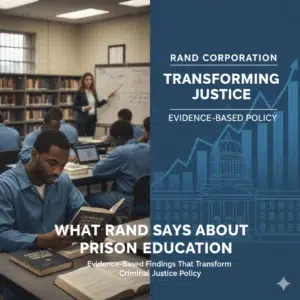
The RAND Corporation’s 2013 meta-analysis represents the most comprehensive examination of correctional education effectiveness ever undertaken. Led by senior policy researcher Lois Davis, the study analyzed decades of research to quantify correctional education effectiveness in reducing recidivism, improving employment, and delivering cost-effectiveness.
RAND researchers examined programs from basic literacy to college-level courses across federal and state facilities. Their methodology carefully accounted for selection bias and motivation differences between participants and non-participants, ensuring robust statistical validity.
The findings proved so conclusive that they shifted the national debate from whether correctional education works to how best to expand these programs. According to the Department of Justice, Attorney General Eric Holder and Education Secretary Arne Duncan jointly announced these results as evidence for expanding federal support for prison education initiatives.
Statistical Evidence That Changed Federal Policy
RAND’s analysis revealed that inmates participating in any educational program—from remedial math to vocational training to college courses—experienced dramatically better outcomes than non-participants. The research examined multiple program types across varying prison security levels and demographics.
The study’s comprehensive evaluation found that correctional education programs reduce recidivism regardless of the educational starting point. Whether addressing basic literacy needs or providing advanced vocational certifications, education consistently improved post-release success rates.
Applied Insight: Federal defendants often express skepticism about dedicating time to education while incarcerated. However, RAND’s data demonstrates that even partial program completion yields measurable benefits. Clients who engage with educational programming, particularly through Bureau of Prisons literacy programs and vocational training, report improved institutional adjustment and stronger family relationships during incarceration—benefits beyond the statistical improvements in recidivism rates.
Breaking Down the 43% Reduction in Recidivism
RAND’s finding that correctional education participants have 43% lower odds of returning to prison represents a transformative discovery in criminal justice research. This reduction translates to 13 percentage points in absolute terms—dropping recidivism from approximately 43% to 30% for program participants.
The research distinguished between different educational levels and their specific impacts on recidivism reduction:
| Program Type | Recidivism Reduction | Employment Impact |
|---|---|---|
| Adult Basic Education | 11-12% | 3% increase |
| High School/GED | 12% | 5% increase |
| Vocational Training | 16% | 28% increase |
| College Programs | 43% | 20% increase |
These statistics, validated across multiple studies compiled by Middle Tennessee State University researchers, demonstrate consistent positive outcomes regardless of geographic location or institutional setting.
Vocational Training’s Unique Employment Benefits
RAND’s analysis paid special attention to vocational and technical training programs, finding that participants were 28% more likely to obtain employment after release than non-participants. This employment boost proves particularly significant given that stable employment represents one of the strongest protective factors against recidivism.
The United States Sentencing Commission’s Federal Bureau of Prisons vocational programs analysis corroborated RAND’s findings, noting variations based on program quality and institutional support.
The Economics of Prison Education: Cost-Benefit Analysis
RAND’s economic analysis revealed that correctional education programs deliver exceptional returns on investment. The direct costs of providing education range from $1,400 to $1,744 per inmate, while the savings from reduced reincarceration total $8,700 to $9,700 per participant over three years.
This 4-to-1 or 5-to-1 return on investment makes prison education one of the most cost-effective criminal justice interventions available. The calculation considers only direct incarceration costs, excluding broader social benefits like reduced victimization, decreased court costs, and improved family stability.
Federal Budget Implications
The Bureau of Justice Assistance incorporated RAND’s cost-benefit findings into federal funding formulas for state correctional education grants. With the federal prison system housing approximately 155,000 individuals as of 2025, the potential savings from universal education access could exceed $500 million annually.
Practical Implication: When advocating for clients’ access to educational programming during plea negotiations or sentencing, defense attorneys can cite RAND’s cost-benefit analysis to demonstrate that supporting education serves both public safety and fiscal responsibility. We have successfully used these economic arguments when negotiating Federal Bureau of Prisons facility designations that offer robust educational opportunities.
Federal Policy Transformation: From RAND Research to Law
RAND’s research catalyzed significant federal policy changes, most notably the restoration of Pell Grant eligibility for incarcerated students and the educational provisions of the First Step Act of 2018.
Second Chance Pell: Reversing the 1994 Ban
The Second Chance Pell Experimental Sites Initiative, launched in 2015, directly cited RAND’s findings to justify restoring federal financial aid for incarcerated students after a 21-year ban. From 2016 to 2022, over 40,000 students participated, earning nearly 12,000 credentials.
In July 2023, Pell Grant eligibility was fully restored for all eligible incarcerated students. The Department of Education estimates that 760,000 individuals qualify for federal financial aid while incarcerated.
First Step Act Educational Provisions
The First Step Act of 2018 incorporated RAND’s findings into its evidence-based recidivism reduction framework. The Act requires the Bureau of Prisons to provide educational programming as a core component of its risk and needs assessment system.
Under the Act’s earned time credit system, inmates can reduce their sentences by up to 15 days per month through participation in approved educational programs. The Bureau of Prisons expanded its educational offerings by 35% between 2022 and 2023 to meet First Step Act requirements.
Bureau of Prisons Implementation: RAND’s Impact on Federal Facilities
The Federal Bureau of Prisons restructured its educational delivery system based on RAND’s recommendations, creating what officials describe as a “school district within the federal prison system.” This reorganization addressed RAND’s findings about program consistency and quality control.
Currently, 84% of federal correctional institutions offer educational programming, though capacity remains limited. The literacy program waitlist exceeds 28,500 individuals, highlighting the gap between demand and available resources despite RAND’s proven benefits.
Evidence-Based Program Selection
The Bureau adopted RAND’s evidence-based criteria for program evaluation, prioritizing interventions with demonstrated recidivism reduction. Programs must show empirical evidence of effectiveness and include measurable outcomes aligned with RAND’s research parameters.
Federal Prison Industries (UNICOR), the Bureau’s vocational training program, expanded based on RAND’s findings showing 24% lower recidivism among participants. The program now operates in over 70 facilities, providing training in manufacturing, services, and technology sectors.
Applied Insight: Federal defendants preparing for incarceration should understand that educational program participation affects more than sentence computation. RAND’s research shows that education improves institutional safety, with facilities offering college programs experiencing less violence among incarcerated individuals. This creates safer environments for both residents and staff, potentially influencing security level designations and transfer opportunities.
Addressing the Skeptics: RAND’s Response to Criticism
Despite overwhelming evidence, some policymakers initially questioned whether education truly caused reduced recidivism or merely correlated with motivated individuals already less likely to reoffend. RAND’s methodology specifically addressed this concern of selection bias.
The research team employed statistical techniques to isolate education’s causal effect, comparing similar individuals who differed only in program participation. Even after controlling for motivation, age, criminal history, and other factors, education’s benefits remained statistically significant.
Subsequent research by independent institutions, including a 2023 meta-analysis reviewing 148 programs, confirmed RAND’s findings. The consistency across studies, time periods, and jurisdictions validates education’s transformative potential.
International Validation
RAND’s findings align with international research on prison education. Studies from Canada, the United Kingdom, and Australia report similar recidivism reductions, suggesting education’s benefits transcend specific correctional systems or cultural contexts.
Current Challenges Despite RAND’s Evidence
Although RAND definitively proved prison education’s effectiveness, implementation challenges persist. The Government Accountability Office identified several barriers limiting program access:
- Technology limitations restrict online learning opportunities, particularly problematic given the shift toward computer-based GED testing. Many facilities lack adequate internet access or updated computer labs necessary for modern educational delivery.
- Geographic transfers disrupt educational continuity when inmates move between facilities. Students may lose credits or find their destination facility lacks equivalent programming, forcing them to restart or abandon their studies.
- Funding constraints limit program capacity despite proven returns on investment. While the Second Chance Act authorized increased appropriations, funding often falls short of authorization levels.
Addressing Implementation Gaps
Recent legislation attempts to address these challenges. The FAFSA Simplification Act of 2020 streamlined financial aid applications for incarcerated students, reducing administrative barriers identified in RAND’s follow-up research.
State-level initiatives, including partnerships between correctional departments and higher education systems, work to standardize credit transfers and ensure program continuity across facilities.
Beyond Recidivism: RAND’s Findings on Broader Benefits
While RAND’s research focused primarily on recidivism and employment, subsequent studies revealed additional benefits of correctional education:
- Family stability improves when incarcerated parents participate in educational programs. Children of educated parents show better academic performance and a reduced likelihood of criminal justice involvement.
- Institutional safety increases in facilities with robust educational programming. RAND noted that education provides structured time, positive peer interactions, and future-focused thinking that reduces disciplinary infractions.
- Mental health outcomes improve among program participants. Education provides cognitive stimulation, a sense of purpose, and self-efficacy that combat the psychological effects of incarceration.
Intergenerational Impact
Research indicates that parental education strongly predicts children’s educational attainment. By enabling incarcerated parents to pursue education, these programs potentially break intergenerational cycles of limited opportunity and criminal justice involvement.
The approximately 2.7 million children with incarcerated parents benefit when their parents return home with improved employment prospects and educational credentials. RAND’s cost-benefit analysis likely underestimates total social returns by excluding these intergenerational effects.
Practical Implication: Defense attorneys representing clients with minor children should emphasize educational programming’s family benefits during sentencing advocacy. Courts increasingly recognize that supporting parental education serves children’s best interests, potentially influencing custody and visitation arrangements post-release.
Future Directions: Building on RAND’s Foundation
RAND continues updating its research as correctional education evolves. Recent focus areas include:
- Technology integration examining how tablets, online learning platforms, and virtual reality can expand educational access within security constraints.
- Individualized programming investigating how risk and needs assessments can match individuals with optimal educational interventions based on learning styles, interests, and reentry plans.
- Post-release continuity studying how to maintain educational engagement during the critical reentry period when individuals face competing demands for housing, employment, and family responsibilities.
The National Institute of Justice funds ongoing research building on RAND’s foundation, particularly examining higher education’s unique benefits compared to basic education programs.
State-Level Implementation of RAND’s Findings
States have embraced RAND’s findings with varying enthusiasm and success. California’s Senate Bill 1391 specifically cited RAND research when expanding community college access in state prisons.
Despite having the nation’s largest state prison system, Texas reports that only 7.8% of bachelor’s degree holders return to prison compared to 43% of non-participants. These outcomes align precisely with RAND’s projections.
New York’s experience particularly validates RAND’s findings. The state’s college-in-prison programs, eliminated in 1995 but gradually restored based on RAND’s evidence, now show recidivism rates below 4% for participants.
Overcoming State-Level Resistance
Some states initially resisted implementing RAND’s recommendations, citing public opposition to “free education for criminals.” However, RAND’s economic analysis proved persuasive to fiscal conservatives concerned about corrections budgets.
Advocates successfully built bipartisan coalitions supporting program expansion by framing education as crime prevention rather than inmate benefit. RAND’s objective, data-driven approach transcended political divides.
RAND Prison Education FAQs
What specific education programs did RAND study?
From 1980 to 2013, the comprehensive RAND Corporation study examined adult basic education, GED preparation, vocational training, and postsecondary education programs across federal and state facilities.
How quickly do education benefits appear after release?
RAND found employment benefits appear immediately upon release, while recidivism reduction becomes statistically significant within the first year and continues throughout the follow-up period.
Does program completion matter, or do partial participants benefit?
While program completion yields maximum benefits, RAND found even partial participation reduces recidivism compared to no participation.
Which inmates benefit most from educational programming?
RAND’s research shows benefits across all demographics, though younger individuals and those with longer sentences show robust responses to educational interventions.
How does RAND’s research compare to other recidivism reduction programs?
Correctional education shows comparable or superior outcomes to many other evidence-based interventions while costing significantly less than intensive therapeutic programs.
Did RAND examine online or distance learning programs?
RAND’s original analysis predated widespread online learning in correctional settings, but subsequent research suggests that properly implemented distance learning achieves similar outcomes.
What educational level provides the best return on investment?
While college programs show the most significant recidivism reduction, vocational training provides the highest return on investment due to lower costs and strong employment outcomes. These prison education statistics demonstrate clear cost-effectiveness.
How many federal inmates currently access education programs?
Approximately 112 evidence-based educational programs operate across federal facilities, though capacity constraints mean many eligible individuals remain on waiting lists.
Does RAND’s research apply to federal and state systems equally?
RAND analyzed both systems and found consistent benefits, though implementation quality varies more in state systems due to funding and policy differences.
What happens to educational credits if an inmate transfers facilities?
Credit transferability remains challenging despite RAND’s recommendations, though recent federal initiatives work to standardize credit recognition across institutions.
Conclusion: RAND’s Enduring Impact on Criminal Justice Reform
RAND’s groundbreaking research answered whether correctional education reduces recidivism, improves employment, saves taxpayer money, and enhances public safety. These findings transformed federal policy, influenced state legislation, and provided defense attorneys with powerful advocacy tools.
Understanding RAND’s findings offers hope and practical guidance for individuals facing federal charges. Education during incarceration represents not merely time well spent but a proven pathway to successful reentry and reduced recidivism.
If you or a loved one faces federal criminal charges, understanding how educational opportunities can impact both incarceration experiences and post-release success proves crucial. Our firm helps clients navigate these opportunities from pre-sentence planning through post-conviction advocacy.
Contact a Federal Criminal Defense Expert at Elizabeth Franklin-Best P.C. for Help Today
Don’t let a federal investigation or criminal charge jeopardize your freedom, career, or future. Elizabeth Franklin-Best P.C. provides experienced federal criminal defense representation to clients across the United States, handling complex cases with precision and strategic insight.
Call (843) 620-1100 or contact us today to speak with a federal criminal defense attorney and take decisive action to protect your rights.
Reviewed for legal accuracy by Elizabeth Franklin-Best, Esq., Principal Attorney·September 2026